
Digital Detox for Students: Why Reducing Screen Time Actually Works
Let me ask you something.
When was the last time you studied for thirty straight minutes without checking your phone?
Not one glance. Not a quick scroll. Nothing.
If you are struggling to answer that, you are not alone. I have worked with enough students over the years to know that the biggest enemy of concentration today is not laziness. It is that small, shiny rectangle sitting next to your notebook.
And here is the uncomfortable truth. Most students know they are glued to their screens. They joke about it. They make reels about it. But they do very little to change it.
That is where a digital detox comes in. But before you roll your eyes and think this is some wellness influencer gimmick, hear me out.
What a Digital Detox Actually Looks Like (No, You Don’t Need to Throw Away Your Phone)
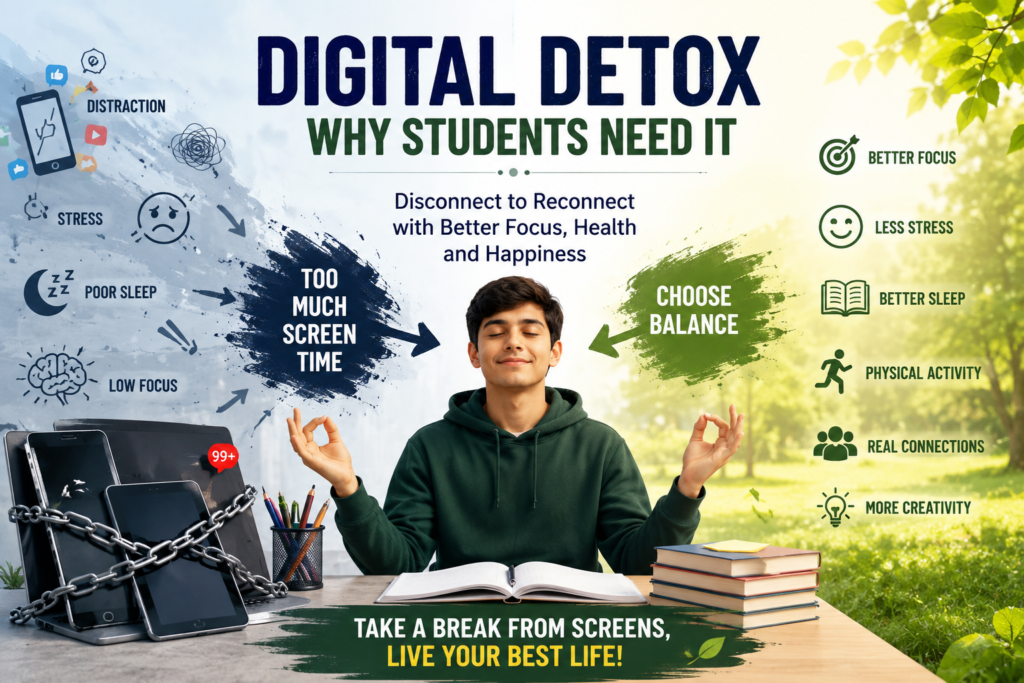
Let me clear one thing up right away.
A digital detox does not mean you sell your laptop and start writing letters by candlelight. That is unrealistic, and frankly, unhelpful.
A real digital detox simply means you take intentional breaks from your devices. You decide when to use them instead of letting them decide when to grab your attention.
Think of it like this. You do not stop eating food because some foods are unhealthy. You just stop eating junk at midnight. Same logic applies here.
For a student, a digital detox could look like:
- Keeping the phone in another room while studying
- Turning off every notification except calls
- Not touching the screen for the first twenty minutes after waking up
- Taking one evening per week completely offline
That is it. Simple, doable, and honestly life-changing if you stick to it.
Why Students Specifically Struggle More Than Anyone Else
Here is something I have noticed over years of observing student behaviour.
Working professionals can come home and leave their laptop in the office bag. Parents can hand over the iPad to their kids and take a break.
But students? Your entire academic life is now digital.
Assignments are submitted online. Study material is on PDFs. Coaching classes stream on apps. Even your doubt-solving happens on WhatsApp groups.
So unlike other people, you cannot simply “switch off” completely. And that is exactly why a digital detox is more important for you, not less.
You are constantly in the grey zone. Studying one minute, scrolling the next. Attending a lecture, then replying to a story. Your brain never gets a clean break. And that constant switching is exhausting your mental energy more than the actual studying does.
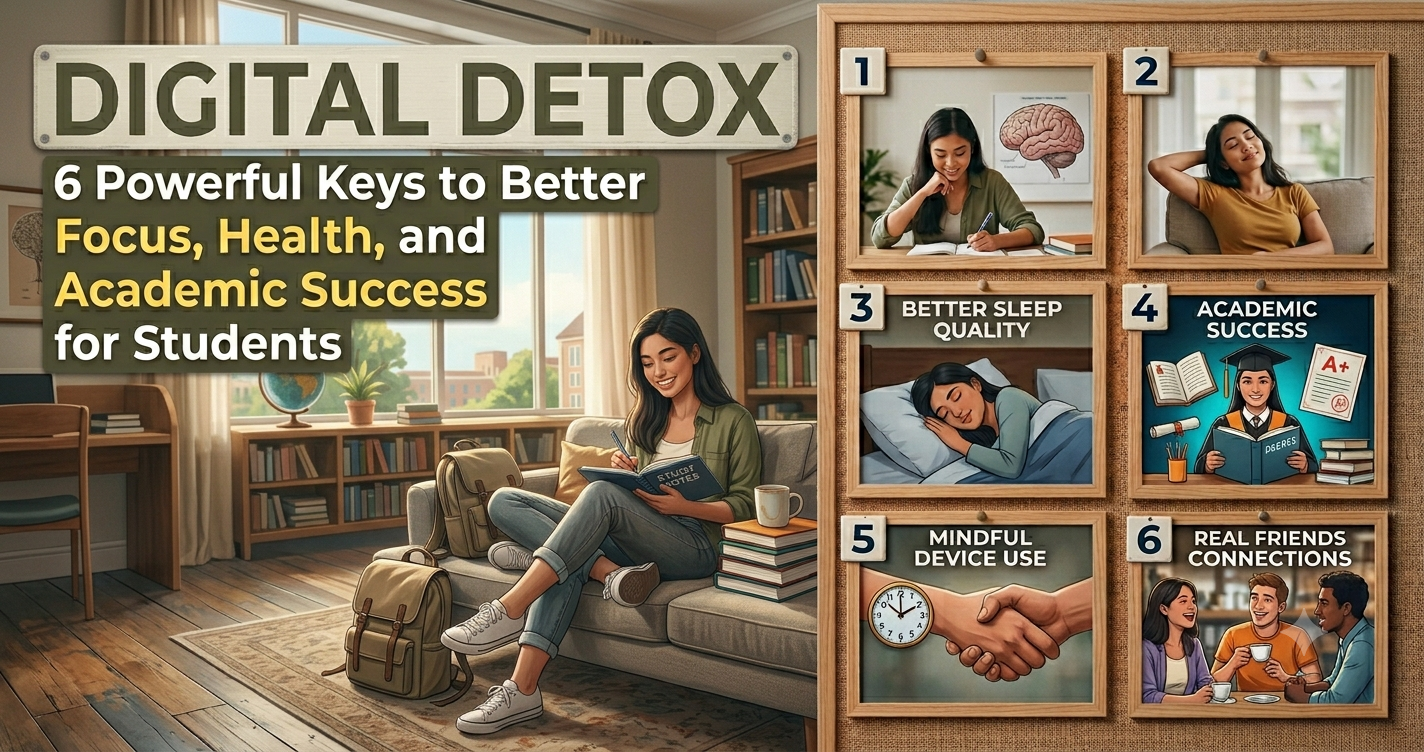
6 Ways Reducing Screen Time Transforms Student Life
Let me walk you through what actually changes when students reduce their digital dependency. These are not theoretical benefits. I have seen these play out again and again.
1. Your Focus Becomes a Superpower Again
Here is a small experiment you can try tonight.
Sit with a chapter you need to finish. Keep your phone in another room. Just for one hour.
You will be shocked by how much your brain resists it at first. You will feel phantom vibrations. You will suddenly remember you need to check that one message. But push through.
After that hour, check how much you actually understood. I promise you, the difference will be visible.
The reason is simple. Every time a notification pops up, your brain has to drag its attention away from your book, process the distraction, and then slowly crawl back to where it was. That process takes anywhere from five to twenty minutes. Do that five times during a study session, and you have effectively wasted an hour without even realising it.
A digital detox removes those interruptions. And suddenly, studying becomes faster and less painful.
2. Your Mood Stops Depending on Other People’s Highlight Reels
Here is something no one tells you about social media.
When you scroll through Instagram or Snapchat, you are not seeing your friends’ real lives. You are seeing the carefully curated two percent they want you to see.
But your brain does not know that. Your brain sees someone having fun, someone scoring marks, someone looking happy, and immediately compares it to your own ordinary Tuesday evening. That comparison is a direct train to anxiety and low self-esteem.
I have had students tell me they feel “behind in life” at seventeen. Behind what? You are not supposed to have everything figured out yet.
Taking a break from that constant comparison gives your mind room to breathe. You stop measuring your worth through likes and story views. And that mental relief shows up in your studies, your relationships, and your sleep.
3. You Stop Fighting Your Own Sleep
Let me ask another question.
What is the last thing you look at before you close your eyes at night?
If the answer is a phone screen, you are actively making it harder for yourself to sleep well.
The blue light coming from your screen tricks your brain into thinking it is still daytime. Your body stops producing melatonin, which is the chemical that actually makes you feel sleepy. So you lie in bed with your eyes closed, but your brain is still wide awake.
Then morning comes, and you wake up exhausted. You blame your alarm. You blame your schedule. But really, you should blame the hour you spent on YouTube shorts in bed.
A digital detox does not ask you to never use your phone at night. It simply asks you to put it down one hour before sleeping. Read a book. Talk to a family member. Listen to music. Anything without a backlit screen. Try it for three days, and you will notice the difference in how fresh you feel in the morning.
4. Your Body Will Thank You (Seriously)
This one is not dramatic, but it is important.
Students today sit more than any generation before. School, coaching, self-study, entertainment—all of it happens while sitting and looking down at a screen.
That posture is wreaking havoc on your neck, shoulders, and eyes. I have seen sixteen-year-olds complain about back pain that used to belong to fifty-year-olds. Dry eyes, headaches, stiff necks—these are not signs of hard work. They are signs of too much screen time with too few breaks.
When you reduce screen time, you automatically find other things to do. You go out. You play something. You walk while talking on a call instead of lying on your bed. These small movements add up. Your body is not designed to be stationary for twelve hours a day. A digital detox gently forces you to move again.
5. Your Real Relationships Stop Feeling Like a Background Task
Here is something that breaks my heart a little.
I have seen families sitting in the same room, each person staring at a different screen. I have seen friends hanging out together but scrolling separately. We are physically together but mentally somewhere else.
A digital detox brings back actual conversations. The kind where you see someone’s face while they talk. The kind where you laugh without needing to record it. The kind that you remember years later, not as a notification, but as a feeling.
For students, these real-life connections are not just nice to have. They are your support system when exams get hard, when results disappoint you, when you feel lost about the future. A text message cannot replace a genuine hug or a patient listening ear. Do not let your screen steal those moments from you.
6. Your Brain Starts Generating Its Own Ideas Again
This last benefit is subtle but powerful.
When you constantly consume content—reels, memes, tweets, videos—your brain stays in passive mode. It receives. It reacts. But it rarely creates.
Have you noticed how hard it is to sit with a blank page now? How your mind immediately reaches for your phone whenever you have a free moment? That is what constant digital consumption does. It kills your boredom, but boredom is actually where creativity comes from.
When you take a break from screens, your brain gets bored. And then something interesting happens. It starts coming up with its own ideas. You remember something you wanted to write. You imagine a drawing you could make. You figure out a different way to solve that math problem.
That is your creativity waking up. And for competitive exam aspirants especially, that ability to think independently is worth more than any crash course.
Realistic Ways to Start a Digital Detox Without Losing Your Mind
Let me be honest with you. Quitting cold turkey does not work. You will last two days and then binge on screen time to compensate.
Here is what actually works for students.
Start small. Pick just one hour every day. Usually, the first hour after waking up or the last hour before sleeping are the easiest to protect. Keep that hour screen-free.
Use physical separation. Your willpower is limited. If your phone is on your desk, you will check it. If it is in your bag, you will check it less. If it is in another room, you might still check it, but at least you have to walk. That pause is enough to stop many mindless checks.
Replace, do not just remove. If you say “I will stop scrolling Instagram,” but have nothing else to do, you will fail. Replace that habit with something else. Keep a book on your desk. Keep a sketchpad nearby. Keep a simple puzzle or a Rubik’s cube. Give your hands and mind an alternative.
Use the one-hour rule for sleep. This is non-negotiable if you want better sleep. One hour before your bedtime, your phone goes on charge outside your bedroom. No exceptions. The first two nights will feel weird. By the fifth night, you will wonder why you ever slept with your phone nearby.
Schedule your scrolling. Instead of saying “less social media,” say “I will check Instagram only between 7 and 7:30 PM.” That way you do not feel deprived. You just postpone the gratification. And most of the time, the urge to check passes after a few minutes anyway.
A Quick Word for Parents and Teachers about Digital Detox
If you are a parent or a teacher reading this, here is what you need to understand.
Telling a student to “just put down the phone” does not work. They know they should. They want to. But their apps are literally designed by billion-dollar companies to be addictive.
Your job is not to scold. Your job is to create an environment where reducing screen time feels easier.
Keep phone charging stations outside bedrooms. Have screen-free family meals. Model the behaviour yourself—if you are checking emails during dinner, do not expect different from your child.
And most importantly, notice and appreciate when they try. If a student successfully studies for two hours without checking their phone, acknowledge that effort. That is genuinely hard in today’s world.
Frequently Asked Questions
Q1. Does a digital detox mean I cannot use my phone for studying at all?
Not at all. The goal is not to remove technology from learning. The goal is to remove mindless scrolling and notification addiction. Use your laptop or phone for online classes, PDFs, and research. Just keep your social media and entertainment apps separate from your study time and study space.
Q2. How long should a digital detox last for students?
You do not need a two-week break from all screens. That is unrealistic. Instead, build daily mini-detoxes. One hour in the morning, one hour before sleep, and screen-free study sessions. Consistency matters more than duration.
Q3. What do I do if I need my phone for a timer or calculator?
Simple. Use a physical timer and a real calculator. Or use your phone but put it on airplane mode before you start studying. The moment internet is off, most distractions disappear automatically.
Q4. Will reducing screen time really improve my exam scores?
Indirectly, yes. It will improve your focus, memory consolidation during sleep, and mental energy. Those three things directly affect your learning and retention. Many students who reduce screen time report finishing their syllabus faster because they waste fewer hours on unproductive scrolling.
Q5. I feel anxious without my phone. Is that normal?
Extremely normal. And also a sign that you need a digital detox more than most people. That anxious feeling is withdrawal, similar to what people experience with any other habit. Start with very small breaks—fifteen minutes, then thirty, then one hour. The anxiety fades faster than you expect.
The Bottom Line
Look, I am not here to tell you that technology is evil. It is not. Your phone helps you study. Your laptop helps you prepare. Your online communities keep you sane during stressful exam seasons.
But here is what I have learned from watching hundreds of students over the years.
The ones who succeed in the long run are not the ones who study the most hours. They are the ones who protect their attention like a precious resource. They know when to be online and when to disappear. They are not afraid to be unreachable for a few hours.
A digital detox is not about rejecting modern life. It is about reclaiming your focus, your sleep, your relationships, and your peace of mind.
And honestly? You deserve all of those things.
So tonight, try one small thing. Put your phone away one hour before sleeping. Just see what happens.
You might be surprised by how much you were missing.
Tags:
Share:
You May Also Like