SBI Clerk Syllabus 2026 & 2027: The Ultimate Guide to Prelims, Mains, and Selection
The State Bank of India (SBI) recruitment for Junior Associates (Customer Support & Sales) remains one of the most competitive banking examinations in India. To secure a seat in 2026 or 2027, candidates must navigate a rigorous selection process that tests speed, accuracy, and depth of knowledge. This comprehensive guide provides the latest syllabus and pattern updates to help you streamline your preparation.
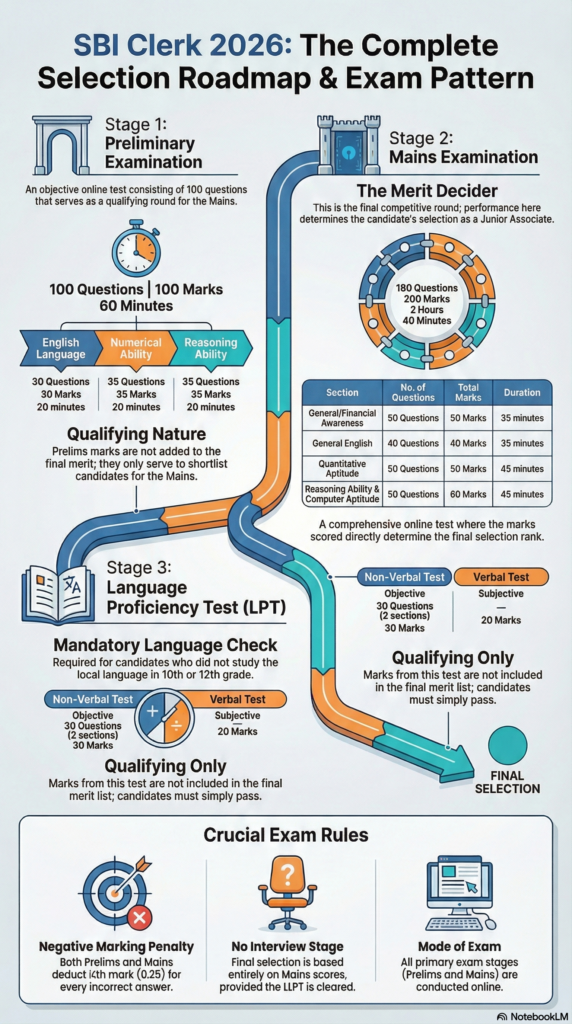
1. Overview of the SBI Clerk 2026-2027 Recruitment
The SBI Clerk exam is conducted online and serves as the gateway to a career in India’s largest public sector bank. The selection is designed to identify candidates with strong aptitude in reasoning, mathematics, and language.
Key Exam Statistics:
- Mode of Exam: Online (Objective).
- Negative Marking: 0.25 marks (1/4th) for every wrong answer in both Prelims and Mains.
- Final Merit: Based solely on the Mains Examination score; Prelims and LLPT are qualifying.
2. The Three-Stage Selection Process
Understanding the hierarchy of the recruitment process is vital for prioritizing your study schedule.
- Stage 1: Preliminary Examination: An online screening test to shortlist candidates.
- Stage 2: Mains Examination: The primary merit-based test that determines final selection.
- Stage 3: Local Language Proficiency Test (LLPT): A qualifying test for those who haven’t studied the local language in school.
[Image Placeholder: Flowchart of the SBI Clerk Recruitment Journey from Application to Final Selection]
3. SBI Clerk Preliminary Exam Pattern (2026-2027)
The Preliminary exam is the first hurdle. It is a 1-hour test that requires extreme speed.
| Section | Questions | Marks | Duration |
|---|---|---|---|
| English Language | 30 | 30 | 20 minutes |
| Numerical Ability | 35 | 35 | 20 minutes |
| Reasoning Ability | 35 | 35 | 20 minutes |
| Total | 100 | 100 | 60 minutes |
(Source:)
Candidates must manage their time effectively within the sectional time limits of 20 minutes per section.
4. Detailed Prelims Syllabus: Subject-Wise Breakdown
A. Numerical Ability Syllabus
This section evaluates your mathematical speed and accuracy. Key topics include:
- Data Interpretation (DI): Bar Graphs, Line Graphs, Pie Charts, and Tabular DI.
- Calculative Topics: Simplification, Approximation, and Missing Number Series.
- Arithmetic Word Problems: Average, Ratio & Proportion, Percentage, Profit & Loss, Simple and Compound Interest, and Time & Work.
- Advanced Concepts: Mensuration (Cylinder, Cone, Sphere), Permutation & Combination, and Probability.
B. Reasoning Ability Syllabus
The Reasoning section tests logical thinking and problem-solving skills:
- Puzzles & Seating Arrangements: Circular, Triangular, Square, and Rectangular formats.
- Logical Sequences: Alphanumeric Series, Ranking, and Direction/Distance tests.
- Core Reasoning: Syllogism, Blood Relations, Coding-Decoding, and Inequalities.
C. English Language Syllabus
The focus here is on grammar, vocabulary, and comprehension:
- Reading Comprehension (RC): The cornerstone of the section.
- Vocabulary & Grammar: Cloze Test, Error Detection, Sentence Rearrangement, and Fillers.
- New Patterns: Column-based sentences, Phrase Replacements, and Word Swapping.
5. High-Scoring Topics for Prelims: Focus Areas
Based on previous years’ trends, certain topics carry higher weightage. Focus your 2026-2027 preparation on these areas to maximize your score:
- Reasoning: Puzzles & Seating Arrangements (12 to 16 questions).
- Numerical Ability: Simplification (10 to 15 questions) and Data Interpretation (5 to 10 questions).
- English: Reading Comprehension (7 to 10 questions) and Cloze Test (5 to 6 questions).
[Image Placeholder: Heatmap or Bar Chart showing topic weightage for Prelims sections]
6. SBI Clerk Mains Exam Pattern (2026-2027)
The Mains exam is longer and more complex, featuring four sections across 2 hours and 40 minutes.
| Section | Questions | Marks | Duration |
|---|---|---|---|
| General English | 40 | 40 | 35 minutes |
| Quantitative Aptitude | 50 | 50 | 45 minutes |
| Reasoning Ability & Computer Aptitude | 50 | 60 | 45 minutes |
| General/Financial Awareness | 50 | 50 | 35 minutes |
| Total | 190 | 200 | 160 minutes |
(Source:)
7. Detailed Mains Syllabus: Advanced Topics
While the core subjects overlap with Prelims, the Mains level is significantly higher.
A. General/Financial Awareness
This section is exclusive to the Mains and is often the “game-changer”:
- Banking Awareness: Banking/Financial terms and news related to the banking industry.
- Current Affairs: National and international news, sports, awards, and new government schemes.
- Static GK: Country-Capitals, Currencies, Power Stations, and Dance Forms.
B. Reasoning & Computer Aptitude
This section combines logical puzzles with technical knowledge:
- Advanced Reasoning: Machine Input-Output, Statement & Assumptions, and Advanced Puzzles.
- Computer Aptitude: Basics of Hardware/Software, Networking, MS Office, and Important Abbreviations.
C. Quantitative Aptitude (Mains)
The focus shifts to complex data interpretation and arithmetic:
- Priority: Data Interpretation (Caselets and combined charts), Data Sufficiency, and Quadratic Equations.
D. General English (Mains)
The difficulty level of Reading Comprehension increases, incorporating more synonyms and antonyms.
8. Local Language Proficiency Test (LLPT)
Candidates who qualify both written tests but did not study the official local language in the 10th or 12th standard must undergo the LLPT.
LLPT Exam Structure:
- Objective (Non-Verbal): 3 passages, 15 questions for 15 marks.
- Verbal Test (Subjective): Covers proficiency in speaking and understanding, worth 20 marks.
Note: LLPT is qualifying in nature; these marks are not added to the final merit list.
9. Strategic Preparation Tips for 2026-2027 Aspirants
To succeed in the SBI Clerk exam, candidates must move beyond basic concepts.
- Analyze Previous Papers: Understand the specific types of questions asked in previous years to identify patterns.
- Mock Tests are Mandatory: Regularly attempting mock tests helps track your score and improves speed under sectional timing.
- Master Calculation Speed: For the Numerical Ability section, practice Vedic maths or shortcut methods to solve Simplification and Number Series questions rapidly.
- Daily Current Affairs: Spend at least 1 hour daily on banking and general awareness to stay updated for the Mains.
[Image Placeholder: An infographic displaying a “Daily Study Routine for SBI Clerk Aspirants”]
10. Frequently Asked Questions (FAQs)
Q1: Is there an interview round for the SBI Clerk? No, selection is based on the marks scored in the Mains exam only.
Q2: What is the total duration of the SBI Clerk Mains exam? The exam lasts 2 hours and 40 minutes.
Q3: Is the SBI Clerk exam easy to crack? It depends on preparation. Historically, Prelims are easy to moderate, while Mains are moderate in difficulty.
Q4: Can I use a calculator in the exam? No, all calculations must be done manually, which is why speed in the Numerical section is crucial.
Conclusion
The path to becoming an SBI Junior Associate requires a disciplined approach to the syllabus and a keen eye on the clock. By focusing on high-scoring topics like Puzzles, Data Interpretation, and General Awareness, you can secure a top rank in the SBI Clerk 2026-2027 cycle.
The Ultimate SBI Clerk Syllabus & Exam Guide 2026-2027: Master Your Path to Success (SEO Edition)
The State Bank of India (SBI) recruitment for Junior Associates (Customer Support & Sales), commonly known as the SBI Clerk exam, is one of the premier banking entrance tests in the nation. For the upcoming 2026 and 2027 recruitment cycles, competition is expected to be fierce, making a thorough understanding of the syllabus and exam pattern more critical than ever.
Success in this exam is not just about intelligence; it is about speed, accuracy, and strategic selection of questions. This guide serves as your comprehensive blueprint, covering every aspect of the examination journey from the first day of Prelims to the final Language Proficiency Test.
Chapter 1: The SBI Clerk Selection Architecture
Before diving into the subjects, you must understand the “Three Pillars” of the selection process. The SBI recruitment is designed to filter thousands of applicants through a tiered system:
- Stage 1 – Preliminary Examination: This is an online objective test. It acts as a gateway or screening process. No matter how high you score in Prelims, these marks are not added to your final selection rank. Its sole purpose is to shortlist candidates for the next round.
- Stage 2 – Mains Examination: This is the “Main Event.” The marks you obtain in this online objective test are the only marks that determine your final merit list position. There is no interview stage for the SBI Clerk position, making the Mains exam the deciding factor in your career.
- Stage 3 – Local Language Proficiency Test (LLPT): A final verification of your ability to communicate with local customers. If you have a 10th or 12th-grade marksheet proving you studied the local language of the state you applied for, you are exempt. Otherwise, you must pass this qualifying test before officially joining.
[Image Placeholder: A “Selection Funnel” showing how candidates progress from Prelims to Mains to LLPT]
Chapter 2: Decoding the SBI Clerk Preliminary Exam Pattern
The Prelims exam is a sprint. You have 100 questions to solve in just 60 minutes.
| Section | Number of Questions | Total Marks | Sectional Duration |
|---|---|---|---|
| English Language | 30 | 30 | 20 minutes |
| Numerical Ability | 35 | 35 | 20 minutes |
| Reasoning Ability | 35 | 35 | 20 minutes |
| Grand Total | 100 | 100 | 60 minutes |
(Source:)
The Rule of Negative Marking
Every mistake comes with a price. For both Prelims and Mains, a negative marking of 0.25 marks is applied for every incorrect response. This means for every four wrong answers, you lose 1 mark from your total score. Maintaining a high accuracy rate is just as important as speed.
Chapter 3: Deep Dive into the Preliminary Syllabus
3.1 Numerical Ability (35 Marks)
This section tests your basic mathematical prowess and calculation speed. For 2026-2027, the syllabus includes:
- Simplification & Approximation (10-15 Questions): These are the easiest marks to grab. Master BODMAS, square roots, cube roots, and percentage-to-fraction conversions.
- Data Interpretation (5-10 Questions): You will encounter Bar Graphs, Line Graphs, Pie Charts, and Tabular data. Success here depends on how quickly you can find averages, ratios, and percentages from raw data.
- Number Series (5 Questions): Find the “Missing” or “Wrong” number in a sequence. Common patterns include square series, prime number gaps, and multiplication-addition logic.
- Quadratic Equations (0-5 Questions): Solving polynomial equations for $x$ and $y$ and comparing their values.
- Arithmetic Word Problems (10-15 Questions): The real test of concepts. Topics include:
- Percentage, Profit & Loss, and Discount.
- Simple Interest (SI) & Compound Interest (CI).
- Ratio & Proportion, Partnership, and Mixture & Allegation.
- Time & Work, Pipes & Cisterns.
- Speed, Distance & Time, Boat & Stream.
- Problems based on Ages and Averages.
- Probability, Mensuration (Area and Volume), and Permutation/Combination.
3.2 Reasoning Ability (35 Marks)
Reasoning is about logic and identifying patterns under pressure:
- Puzzles & Seating Arrangements (12-16 Questions): This is the core of the section. Be prepared for:
- Circular, Square, and Rectangular Seating (facing inside/outside).
- Linear Seating (single or double row).
- Box Puzzles, Floor Puzzles, and Day/Month/Year-based puzzles.
- Syllogism (3-5 Questions): Test your logical deduction using Venn diagrams. Watch out for “Only a few” cases.
- Coding-Decoding (3-5 Questions): Common types include Chinese coding or letter-shifting logic.
- Inequality (3-5 Questions): Comparing variables like $A > B \ge C$.
- Miscellaneous (5-10 Questions):
- Blood Relations (family trees).
- Direction & Distance.
- Alphanumeric Series & Ranking.
- Pair formation and Meaningful Word creation.
3.3 English Language (30 Marks)
Success in English requires a mix of grammar knowledge and reading speed:
- Reading Comprehension (7-10 Questions): Reading a passage and answering questions on theme, tone, and direct facts.
- Cloze Test (5-6 Questions): Filling blanks in a passage based on contextual meaning.
- Error Detection & Sentence Correction (5 Questions): Identifying grammatical mistakes in a sentence.
- Para Jumbles (4-5 Questions): Re-arranging 5-6 sentences into a coherent paragraph.
- Fillers: Single or double blanks.
- Word Swap & Usage: Identifying if a word is used correctly in multiple contexts.
[Image Placeholder: A visual checklist of “Must-Do” topics for Prelims]
Chapter 4: The Mains Examination – The Gateway to Selection
The Mains exam is longer (2 hours and 40 minutes) and significantly tougher.
| Section | Questions | Marks | Duration |
|---|---|---|---|
| General/Financial Awareness | 50 | 50 | 35 minutes |
| General English | 40 | 40 | 35 minutes |
| Quantitative Aptitude | 50 | 50 | 45 minutes |
| Reasoning Ability & Computer Aptitude | 50 | 60 | 45 minutes |
| Total | 190 | 200 | 160 minutes |
(Source:)
The Weightage Shift
Notice that Reasoning Ability and Computer Aptitude carries more weightage (60 marks for 50 questions). This means some questions in this section carry 1.2 or 2 marks each. Similarly, General Awareness is the largest single-section mark contributor alongside Quant.
Chapter 5: Detailed Mains Syllabus & Subject Analysis
5.1 General and Financial Awareness (50 Marks)
This section requires consistent daily reading rather than last-minute cramming:
- Current Affairs: Focus on news from the 6 months prior to the exam. This includes national/international news, sports (IPL, Olympics, World Cups), and awards/honors.
- Banking Awareness: History of SBI, RBI functions, monetary policy, types of bank accounts, and digital banking (UPI, NEFT, RTGS).
- Financial Awareness: New government schemes (PMJDY, etc.), Union Budget, and Economic Survey summaries.
- Static GK: Country-capitals and currencies, headquarters of major financial organizations (RBI, SEBI, IRDAI, IMF, World Bank), constituencies of ministers, and national parks/dams.
5.2 Quantitative Aptitude (50 Marks)
In the Mains, simple arithmetic is replaced by complex application:
- High-Level Data Interpretation: Look for Caselet DIs, Missing DIs, and Data Sufficiency (determining if given statements are enough to answer the question).
- Quadratic Equations: More complex forms or comparison of multiple roots.
- Arithmetic: The difficulty level increases; concepts remain the same, but questions are longer and multi-layered.
5.3 Reasoning Ability & Computer Aptitude (60 Marks)
This section is designed to test your mental stamina:
- Advanced Reasoning: Machine Input-Output, Coded Inequalities, Coded Blood Relations, and Coded Direction Sense.
- Critical Reasoning: Statements and Assumptions, Course of Action, Cause and Effect, and Strong/Weak arguments.
- Puzzles: Multi-variable puzzles (e.g., 7 people in different cities with different cars).
- Computer Aptitude: Basics of computers, networking, internet, MS Office (Excel and Word shortcuts are popular), and database management systems (DBMS).
5.4 General English (40 Marks)
Expect more complex Reading Comprehension with abstract themes (economy, psychology, environment). Focus on:
- Synonyms and Antonyms within the passage context.
- Advanced Para Jumbles.
- Sentence Connector and Sentence Starter questions.
Chapter 6: Priority Topics – The “Gold Mine” for Scores
If you are short on time, master these “High Scoring Topics” first:
| Section | High Scoring Topic | No. of Questions (Approx) |
|---|---|---|
| Reasoning | Puzzles & Seating Arrangements | 12 – 16 |
| Quant | Simplification & Approximation | 10 – 15 |
| Quant | Data Interpretation (DI) | 5 – 10 |
| English | Reading Comprehension | 7 – 10 |
| English | Cloze Test | 5 – 6 |
Chapter 7: The Local Language Proficiency Test (LLPT)
The LLPT is the final gatekeeper. It ensures that if you are posted in a rural branch in Maharashtra, you can speak Marathi, or in Tamil Nadu, you can speak Tamil.
- Nature: Qualifying only (marks are not added to the final 200 marks of Mains).
- Format:
- Objective Test: 15 questions based on 3 passages (15 marks).
- Verbal Test: Subjective evaluation of your speaking and listening skills (20 marks).
Chapter 8: Expert Preparation Strategy for 2026-2027
Step 1: The Concept Phase (Months 1-2)
Don’t worry about time yet. Focus on understanding the “Why” and “How” of every topic. Use standard textbooks or online courses.
Step 2: The Practice Phase (Months 3-4)
Start solving topic-wise quizzes. Aim for 100 questions per topic to build muscle memory.
Step 3: The Mock Test Phase (Months 5-6)
This is where you become an “exam warrior.”
- Take full-length mock tests to simulate the actual exam environment.
- Analyze your mocks: Spend more time analyzing why you got a question wrong than you spent taking the test.
- Practice sectional timing specifically for the Prelims.
Chapter 9: Frequently Asked Questions (FAQs)
Q: Can I apply for the SBI Clerk in a state whose language I don’t know? Yes, but you will have to pass the LLPT before joining.
Q: Is there a sectional cutoff in the SBI Clerk exam? No, as per recent patterns, SBI has removed sectional cutoffs. You only need to clear the overall aggregate cutoff for the state and category you applied for.
Q: How many marks is the Mains exam out of? The total marks for the Mains exam is 200 marks.
Q: Is Computer Aptitude very technical? No, it focuses on functional knowledge like MS Office, internet basics, and networking, rather than deep programming.
Final Thoughts
The journey to becoming an SBI Clerk in 2026-2027 is a marathon of consistency. With 100 marks in Prelims and 200 marks in Mains on the line, every single question counts. Use the detailed syllabus above as your checklist, solve as many mock tests as possible, and stay updated with daily banking news.
- IBPS Clerk Syllabus 2026, Mains Exam Pattern Revised
- IBPS PO Syllabus 2026 – Complete Prelims, Mains & Interview Guide (Latest)
SBI Clerk syllabus 2026, SBI Clerk syllabus 2027, SBI Clerk latest syllabus, SBI Clerk prelims syllabus 2026, SBI Clerk mains syllabus 2026, SBI Clerk exam pattern 2026, SBI Clerk exam pattern 2027, SBI Clerk selection process, SBI Clerk syllabus and exam pattern 2026, SBI Clerk detailed syllabus 2027, SBI Clerk syllabus pdf download, SBI Clerk preparation strategy 2026, SBI Clerk study plan 2027, SBI Clerk subjects list, SBI Clerk prelims topics list, SBI Clerk mains topics list, SBI Clerk English syllabus, SBI Clerk reasoning syllabus, SBI Clerk quantitative aptitude syllabus, SBI Clerk general awareness syllabus mains, SBI Clerk computer awareness syllabus, SBI Clerk banking awareness syllabus, SBI Clerk preparation tips, SBI Clerk exam guide 2026, SBI Clerk syllabus topic wise, SBI Clerk syllabus for beginners, SBI Clerk high scoring topics, SBI Clerk syllabus with weightage, SBI Clerk prelims vs mains syllabus, SBI Clerk syllabus analysis 2026, SBI Clerk latest update syllabus, SBI Clerk notification syllabus 2026, SBI Clerk exam preparation tips 2027, SBI Clerk syllabus in Hindi, SBI Clerk syllabus in English, SBI Clerk complete syllabus guide, SBI Clerk study material free, SBI Clerk mock test syllabus, SBI Clerk previous year syllabus comparison, SBI Clerk exam strategy 2026 2027, SBI Clerk syllabus overview, SBI Clerk exam topics breakdown, SBI Clerk syllabus for IBPS aspirants, bank exam syllabus SBI Clerk, SBI Clerk clerk exam preparation 2026, SBI Clerk syllabus important topics, SBI Clerk syllabus ultimate guide, SBI Clerk exam success tips, SBI Clerk syllabus for SSC students, SBI Clerk syllabus latest update 2027, SBI Clerk prelims and mains full syllabus